•
Machado Home
• Research
Fig Mutualism
Drosophila
Trypanosoma
• People
• Publications
• Teaching
• Links
• Research
opportunities
and contact information |
Drosophila
Research
We study the genomics of species divergence in Drosophila. We are currently conducting the following studies:
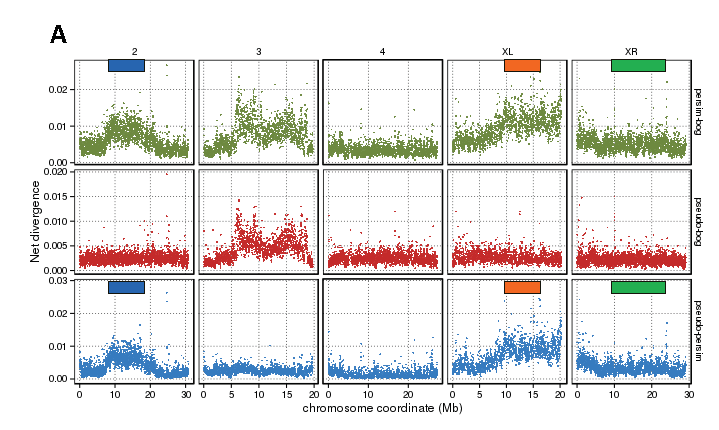
1. We are interested in understanding the roles of gene flow and natural selection during speciation. We are using population genomic data to disentangle the history of divergence of closely related species and to make inferences about historical gene flow and natural selection that have occurred on some, but not all loci in the genome. We study the divergence between Drosophila pseudoobscura and its close relatives D. pseudoobscura bogotana and D. persimilis. We have identified regions of the genome in which these species appear to have or have not exchanged genes recently, and we have also identified islands of divergence outside the already well known divergent regions associated with fixed chromosomal inversions between species. The presence of chromosomal inversions preclude fine scale genetic analyses to characterize the genetic basis of species isolation mechanisms or phenotypic differences between species. However, using population genomic analyses we are obtaining a detailed portrait of the divergence of this species group.
2. We use transcriptome data to characterize phenotypic divergence between species and between the sexes through development.
3. We study the evolution of long non-coding RNAs (lncRNAs), genomic elements that appear to have very important roles in organismal biology. We know very little about the evolution and function of these genomic elements, but work we have conducted suggests that lncRNAs may be important in male-specific processes involved in species divergence in Drosophila. We are conducting a detailed study to characterize the evolutionary forces underlying the divergence of lincRNAs at the gene expression and sequence levels using population genomic and population developmental transcriptome data from D. pseudoobscura and D. persimilis.
|
